
Unruly Abortions: Between Refusal and Prefiguration
Venue
Room 1.55, Edinburgh Futures Institute,The University of Edinburgh
1 Lauriston Place, Edinburgh, EH3 9EF
Media
Image
Description
Since the 1980s, people have used medications to terminate pregnancies outside of formal healthcare settings. What began as a practice on the margins of the Brazilian health system has since evolved into a globally diffused, de-medicalized model of abortion care, driven by a transnational and locally embedded constellation of actors. This practice—self-managed abortion—is often framed in opposition to legality, yet it is not merely a response to restrictive laws. Rather, it represents a deliberate refusal to center the law as the primary determinant of access, safety, or legitimacy.
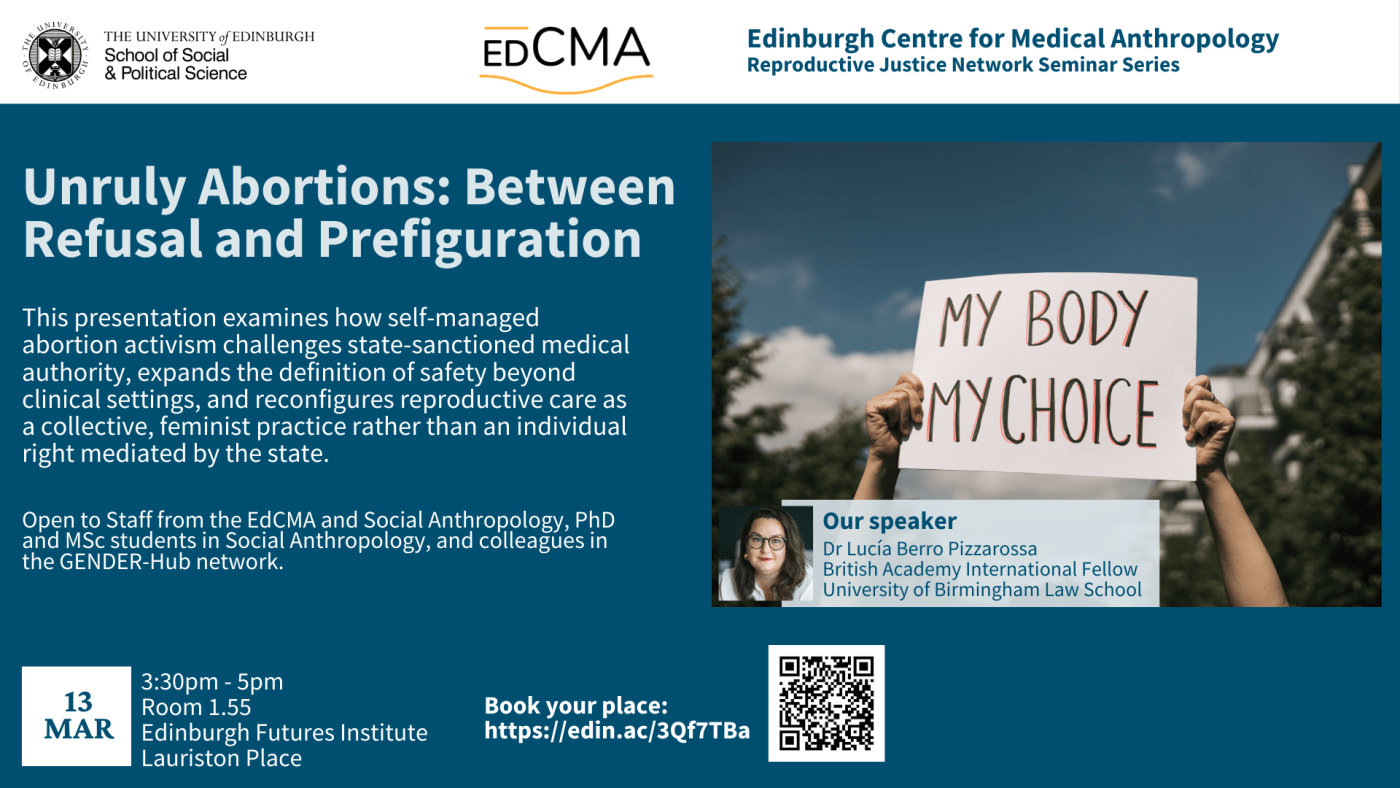
By privileging autonomy, community-based care, and experiential knowledge, self-managed abortion disrupts dominant legal-medical paradigms, making visible alternative frameworks in which care, safety, and citizenshipemerge as central. This presentation examines how self-managed abortion activism challenges state-sanctioned medical authority, expands the definition of safety beyond clinical settings, and reconfigures reproductive care as a collective, feminist practice rather than an individual right mediated by the state. Through the work of activists who provide information and services outside of formal healthcare systems, self-managed abortion has generated distributed networks of support, where knowledge circulates, risks are collectively navigated, and care is reconceptualized on community-driven terms.
Rather than treating legality as the foundation of reproductive rights, self-managed abortion insists on bodily autonomy as a lived, enacted, and relational practice, forging new modes of political belonging and citizenship that are not contingent on state recognition. This presentation, drawing on qualitative interviews with self-managed abortion activists, argues that self-managed abortion is not simply an act of resistance, but a radical prefigurative politics—a refusal that simultaneously envisions and enacts alternative reproductive futures.
This is an in-person event, which takes place in Room 1.55, Edinburgh Futures Institute, 1 Lauriston Place.
This event may be recorded. The recording will be used for internal University of Edinburgh teaching purposes only.
The event is organised and chaired by Chiara Chiavaroli, Teaching Fellow, Social Anthropology, and Lucy Lowe, Senior Lecturer in Medical Anthropology, University of Edinburgh.
Abour our Speaker:

Dr. Lucía Berro Pizzarossa is a British Academy International Fellow at the University of Birmingham and an Affiliated researcher of the Global Health and Rights Project at The Petrie - Flom Center for Health Law Policy, Biotechnology, and Bioethics at Harvard Law School.
Lucía was a Visiting Fellow at the London School of Economics and held post-doctoral positions at the O’Neill Institute for National and Global Health Law at the University of Georgetown and the Faculty of Law at the University of Groningen. She holds a Ph.D. in International Law from the University of Groningen, an M.Jur. fromthe University of Oxford, and an L.L.B. from the Universidad de la Republica in Uruguay.
She has consulted for UNICEF, WHO, International Commission of Jurists, and others. Her academic work has been published in renowned peer reviewed journals such as Reproductive Health Matters, Harvard Health and Human Rights, and BMC International Health and Human Rights.
Key speakers
- Dr Lucía Berro Pizzarossa, British Academic International Fellow, University of Birmingham